Published
May 7, 2026
Tags
Campus K • Classroom Design • Learning Spaces
Why Campus K's Classrooms Look Nothing Like a School and Why That Is Entirely the Point
No rows. No fixed desks. Teachers who do not move between classrooms. Here is the thinking behind how Campus K designed its learning spaces and why it changes outcomes.
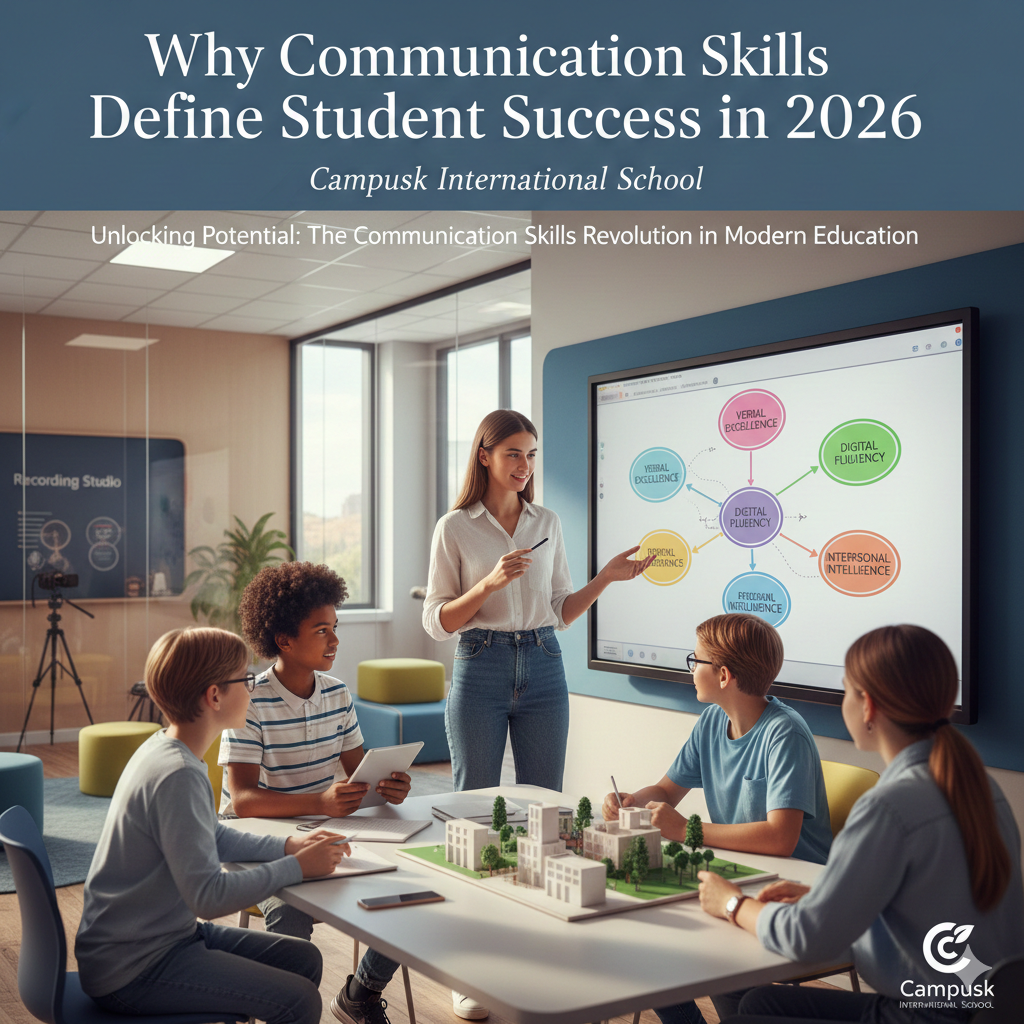
The first thing most parents notice when they walk into a Campus K learning space is that it does not look like a classroom.
It has the geometry of enquiry, not the geometry of instruction.
There are no rows of desks facing a board. No single focal point directing every child’s attention in the same direction at the same time.
The physical design of a learning environment is not aesthetic. It is pedagogical.
The Space Is the Message
Every design decision communicates what learning is supposed to feel like.
At Campus K, every element of the learning space was intentionally designed to communicate curiosity, collaboration, exploration, and ownership.
The Problem With Rows
The traditional row-based classroom was designed for efficient information transfer: one adult speaking, many children listening.
But the world children are entering today values something very different:
Critical Thinking
Analysing ideas instead of memorising them.
Collaboration
Solving problems alongside other people.
Creativity
Exploring multiple possible solutions.
Independent Learning
Investigating instead of passively receiving.
A child who spends twelve years sitting in rows learns an invisible lesson:
Knowledge lives at the front of the room and flows toward them.
Campus K intentionally rejects that message.
What Learning Corners Actually Do
Campus K learning spaces are organised around dedicated learning corners rather than rows of desks.
Each corner supports a different type of cognitive activity.
Mathematics Corner
Supports quantitative reasoning and spatial thinking.
Literacy Corner
Encourages reading, communication, and expression.
Exploratory Corner
Designed for investigation, experimentation, and making.
Collaborative Workspace
Built for discussion, teamwork, and shared problem solving.
These spaces remain consistent across year groups, allowing younger students to observe older learners and creating continuity across learning journeys.
The message is clear:
Learning is not divided into isolated years. It is continuous growth.
Why Teachers Do Not Move Between Classrooms
In most schools, teachers move from room to room according to the timetable.
Campus K reverses this approach.
Learning spaces are anchored to teachers rather than to student batches. Teachers remain in their environments while children move between spaces based on learning needs.
This creates deeper environmental mastery:
- Teachers optimise the space over time
- Materials remain intentionally organised
- Learning flow becomes smoother
- Teachers observe behavioural patterns more closely
The result is a learning environment that becomes increasingly refined and responsive.
Managing Productive Noise
One of the most common questions parents ask is about noise.
If children are collaborating, moving, and discussing ideas simultaneously, how is the environment managed?
Productive Noise vs Disruptive Noise
Productive noise is the sound of thinking happening aloud: debating, discussing, explaining, questioning, collaborating.
Campus K intentionally designs for productive noise because engagement is rarely silent.
Self-regulation habits, reflective practice, and environmental structure help children manage their attention and impact on shared spaces over time.
The New Campus Takes This Further
The new Campus K campus was designed entirely around the school's learning philosophy.
Larger, more flexible learning spaces allow multiple forms of cognitive activity to happen simultaneously.
The infrastructure now fully reflects the philosophy:
- Spaces designed for enquiry
- Flexible collaborative environments
- Exploration-first architecture
- Learning environments built around children
The infrastructure now matches the philosophy at every level.
The Space Is the Message
Every child who spends years sitting in rows receives a message about what learning is supposed to be.
Every child who spends years in a Campus K learning environment receives a very different message:
- Learning is active
- Curiosity is welcome
- Ideas are meant to be explored
- Knowledge is constructed, not delivered
- The environment exists for the learner
That message, repeated every day for years, shapes the kind of learner a child becomes.
Experience the Space Yourself
The best way to understand the Campus K philosophy is to walk through the learning spaces and see how children interact with them in real time.